For over a century, paleontologists have grappled with one of the most enduring mysteries in evolutionary biology: were dinosaurs warm-blooded like modern birds and mammals, or cold-blooded like their reptilian ancestors? The debate has raged in academic circles, fueled by fragmentary evidence and competing interpretations. Now, a groundbreaking study published in Science Advances has turned to an unexpected source for answers: the intricate microvascular networks preserved within dinosaur bone tissue. This research doesn't just aim to settle the metabolic debate; it seeks to map the very evolutionary pathway that may have led from sluggish reptiles to the energetic creatures that dominated the Mesozoic era.
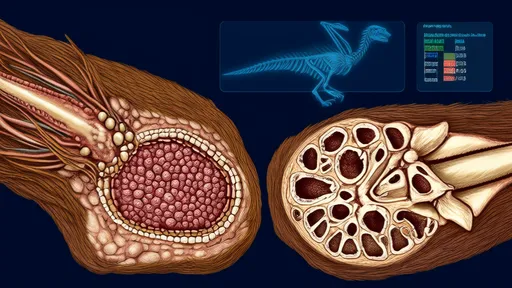
The new research, led by a team of paleohistologists from the University of Bristol, moves beyond traditional methods of counting growth rings or estimating body size. Instead, they employed high-resolution CT scanning and synchrotron imaging to analyze the density and structure of the canaliculi—the tiny canals that housed blood vessels and cells within the bone. This microvascular network is the engine room of bone remodeling and growth, and its complexity is directly linked to an animal's metabolic rate. Warm-blooded animals, which need to constantly generate internal heat, have bones packed with a dense, chaotic web of these canals to facilitate rapid nutrient delivery and growth. Cold-blooded animals, by contrast, have a sparser, more orderly arrangement.
The team created a vast comparative dataset, analyzing the bone microstructure of over 50 extinct and extant species. This included theropods like Tyrannosaurus rex, long-necked sauropods, hadrosaurs, and ceratopsians, as well as modern birds, mammals, lizards, and crocodiles. The results painted a nuanced and fascinating picture of dinosaur physiology. The analysis revealed that the microvascular density in many dinosaur groups, particularly theropods and ornithischians, was incredibly high—rivaling and even surpassing that of modern warm-blooded mammals. This suggests a highly active lifestyle and a metabolism capable of sustaining internal temperature regulation.
However, the story is not one of a simple binary switch. The research traces the evolution of this complex trait through time. Early dinosaurs like Eoraptor show a vascular density intermediate between that of ancient reptiles and their later descendants. This indicates that the high metabolic rate associated with endothermy was not a sudden invention but a trait that was gradually amplified over millions of years. The study posits that the evolution of this advanced cardiovascular system was a key adaptive breakthrough, allowing dinosaurs to colonize a wider range of environments and outcompete other reptiles of their time.
Perhaps the most compelling evidence comes from the link between dinosaurs and birds. The analysis shows an unbroken continuum of increasingly dense microvascular networks from theropod dinosaurs through to Archaeopteryx and modern birds. This provides powerful, physical evidence that the warm-bloodedness of birds is a direct inheritance from their dinosaurian ancestors. It wasn't a new feature that evolved for flight; rather, flight may have been made possible by the high-energy metabolism dinosaurs had already evolved.
This research fundamentally reshapes our understanding of dinosaur biology. It moves the conversation from a simplistic "warm vs. cold" debate to a more dynamic model of metabolic evolution. It suggests that many dinosaurs, especially the later, more derived groups, operated with a metabolic engine far more powerful than that of any modern reptile, perhaps even venturing into a unique physiological category all their own. The secrets to their 160-million-year reign on Earth were not just written in their teeth and claws, but etched into the very fabric of their bones.

By /Aug 25, 2025

By /Aug 25, 2025

By /Aug 25, 2025

By /Aug 25, 2025

By /Aug 25, 2025

By /Aug 25, 2025

By /Aug 25, 2025
By /Aug 25, 2025
By /Aug 25, 2025
By /Aug 25, 2025

By /Aug 25, 2025

By /Aug 25, 2025
By /Aug 25, 2025

By /Aug 25, 2025

By /Aug 25, 2025

By /Aug 25, 2025

By /Aug 25, 2025

By /Aug 25, 2025

By /Aug 25, 2025
By /Aug 25, 2025
