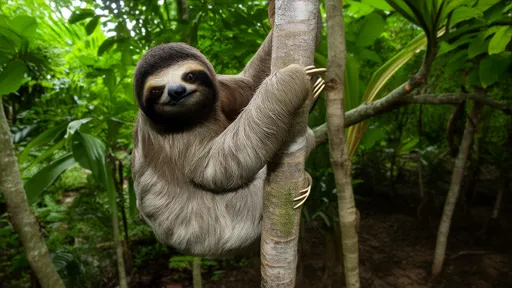
In the dense, humid canopies of Central and South American rainforests, one of nature’s most deliberate creatures moves through life at a pace that defies modern urgency. The sloth, an animal so named for its languid demeanor, has perfected an existence governed by patience, conservation, and profound slowness. While it is often repeated that sloths descend from their arboreal homes only once a week, this behavioral tidbit is but a surface-level glimpse into a far deeper and more intentional way of being—a veritable philosophy of slow living encoded in their very biology.
To understand the sloth is to abandon the human metrics of productivity and speed. Every aspect of its life—from metabolism to movement, from digestion to reproduction—is calibrated for energy conservation and survival in a resource-limited environment. Their famously slow movement isn’t laziness; it is a highly evolved strategy. By moving incrementally and with minimal exertion, sloths become nearly invisible to predators like harpy eagles and jaguars. Their green-tinged fur, a result of a symbiotic relationship with algae, provides camouflage amidst the leaves, making them less a distinct animal and more a living, breathing part of the tree itself.
The much-cited weekly descent is primarily for one critical purpose: elimination. Sloths relieve themselves on the ground, a behavior that scientists believe is connected to their complex ecosystem interactions. This risky journey—risky because it exposes them to terrestrial predators—is a testament to the intricate balance they maintain. Even this vulnerability is integrated into their slow-life approach; it is a calculated risk, undertaken with a purpose that benefits their health and their environment, as moths that live in their fur lay eggs in the dung, continuing a unique life cycle.
Digestion offers another window into this philosophy. Sloths possess a multi-chambered stomach that digests their tough, leafy diet with glacial slowness, sometimes taking up to a month to process a single meal. This extremely low metabolic rate means they require very little energy input to survive, allowing them to thrive on a diet that would be insufficient for more active mammals. Their body temperature fluctuates with the ambient environment, further reducing the caloric burn required to maintain homeostasis. In a world screaming for constant fuel and combustion, the sloth is a master of efficiency, a testament to the power of doing less.
This biological reality echoes a growing human movement toward mindfulness and deceleration. In our hyper-connected, fast-paced world, the sloth’s existence poses a silent, challenging question: What if we prioritized conservation over consumption? What if we valued deliberate action over frantic reactivity? The sloth does not rush; it simply is. It spends its hours hanging, feeding, and resting, fully immersed in its present moment and environment. There is no anxiety about what it hasn’t accomplished, only the steady, rhythmic reality of its existence.
Furthermore, the sloth’s life is a lesson in interdependence. It does not live as an isolated entity but as a mobile ecosystem. The algae in its fur provides camouflage and nutrients, while certain moth species rely exclusively on the sloth for their life cycle, living in its fur and reproducing in its dung. This symbiotic existence underscores that slow living isn’t about isolation or selfishness; it is about understanding one’s place within a wider network and moving in a way that sustains the whole. The sloth’s slow pace allows these relationships to flourish, making its very body a sanctuary for other forms of life.
Observing the sloth, one cannot help but reflect on the modern cult of speed. We celebrate busyness, multitasking, and rapid innovation, often at the expense of our well-being and our planet. The sloth, in stark contrast, achieves remarkable evolutionary success through the opposite principles. It is a survivor, having persisted for millions of years by mastering the art of minimal expenditure. Its "laziness" is, in fact, a profound form of intelligence—an understanding that not all progress is linear and that sometimes, the most powerful action is inaction.
In embracing its inherent slowness, the sloth has unlocked a form of resilience. It does not fight its nature but leans into it completely. There is a deep integrity in this way of life, a harmony between action and being that many humans spend a lifetime seeking. The animal does not aspire to be faster or more productive; it is perfectly adapted to its niche. This self-acceptance is perhaps the most poignant aspect of its philosophy. In a culture obsessed with self-optimization and relentless improvement, the sloth is a quiet but powerful symbol of contentment with one’s own inherent design.
Ultimately, the sloth’s weekly journey to the forest floor is more than a quirky factoid. It is a ritual that encapsulates its entire worldview—a necessary, purposeful, and mindful act in a life defined by intention rather than impulse. The sloth teaches us that speed is not synonymous with efficiency, that visibility is not necessary for impact, and that true strength often lies in the ability to be still. In the whispered rustle of the canopy, the sloth continues its slow, steady dance with time, offering a living testament to the power of moving at your own pace, and in doing so, mastering the art of life itself.

By /Aug 25, 2025
By /Aug 25, 2025
By /Aug 25, 2025

By /Aug 25, 2025
By /Aug 25, 2025
By /Aug 25, 2025

By /Aug 25, 2025
By /Aug 25, 2025

By /Aug 25, 2025

By /Aug 25, 2025
By /Aug 25, 2025
By /Aug 25, 2025
By /Aug 25, 2025

By /Aug 25, 2025
By /Aug 25, 2025
By /Aug 25, 2025
By /Aug 25, 2025
By /Aug 25, 2025
By /Aug 25, 2025
By /Aug 25, 2025
