In the quiet corners of gardens and forests, an extraordinary biological drama unfolds largely unnoticed. The humble garden snail, a creature often overlooked, possesses a remarkable ability that has captivated scientists for decades: the capacity to regenerate its eyes, along with its iconic tentacles, after injury or loss. This isn’t a simple repair job; it is a complex process of rebuilding a fully functional sensory organ from scratch, a feat that remains a distant dream in human medicine. The study of this ability opens a window into fundamental questions of regeneration, development, and evolutionary biology.
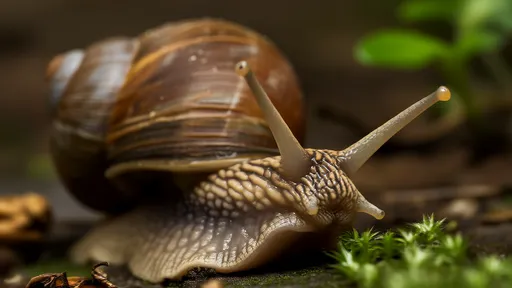
The snail's head features two pairs of tentacles. The smaller, lower pair are primarily olfactory organs, used for smelling and tasting the environment. The larger, upper pair are the star players in this story. Each of these longer tentacles is a sophisticated sensory package. At its tip sits a well-developed eye, complete with a lens and retina, capable of detecting light and shapes, though likely in a rudimentary way compared to vertebrate vision. These tentacles are also equipped with sensory cells for touch and smell, making them critical for navigation, finding food, and avoiding predators. They are constantly probing the world, and as such, are vulnerable to damage.
The moment of injury triggers an immediate and coordinated response. If a tentacle is severed, the snail quickly retracts the remaining stump into its body to minimize fluid loss and prevent infection. Almost immediately, a layer of specialized epidermal cells migrates to cover the wound, forming a protective layer called the wound epithelium. This is the first critical step, sealing the site and preventing complications that could derail the entire regenerative process. Beneath this new layer, a population of seemingly ordinary cells springs into action.
These are the real heroes of regeneration: stem cells or dedifferentiated cells. In many animals, including humans, the potential of cells becomes restricted as they develop into specific tissues like muscle or nerve. Snails, however, appear to maintain a reservoir of cells that can be reprogrammed, or they can cause mature cells at the injury site to revert to a more primitive, flexible state—a process known as dedifferentiation. These activated cells then begin to proliferate rapidly, forming a mound of unspecialized tissue called a blastema. The blastema is the raw material, the cellular clay from which the new tentacle and eye will be sculpted.
The transformation of the blastema into a new organ is a masterpiece of biological engineering. It is not a random growth but a highly orchestrated process guided by a symphony of genetic signals. Key developmental genes and signaling pathways, many of which were active during the snail's initial embryonic development, are switched back on. Morphogens—signaling molecules that create concentration gradients—provide positional information, telling the cells whether they should become part of the base, the shaft, or the tip of the new tentacle. This ensures the new structure grows to the correct size, shape, and orientation. Gradually, cells within the blastema begin to differentiate, giving rise to the complex array of tissues needed: new muscle fibers to control movement, new nerve cells to re-establish connections to the brain, new connective tissue for structure, and of course, the intricate tissues of a new eye.
Perhaps the most astonishing part of this process is the re-wiring of the nervous system. The new tentacle is useless unless it can communicate with the snail's brain. The nerve axons from the newly formed neurons in the tentacle must grow back along the correct path and find their specific target regions in the central nervous system to restore sensory function. How the regenerating neurons navigate this complex journey with such precision is a major focus of research, with implications for treating spinal cord and nerve injuries in humans.
From an evolutionary perspective, the why is as intriguing as the how. Why have snails retained this costly and energetically demanding ability while many other animals, including mammals, have lost most of it? The answer likely lies in their lifestyle and defense mechanisms. Unlike animals that can flee quickly, snails are slow-moving and vulnerable. Their shell offers protection for their main body, but their vital sensory tentacles are exposed. The ability to quickly regenerate a lost tentacle is a tremendous survival advantage. A snail that loses an eye to a pecking bird or a careless footstep can, within a few weeks, be back to surveying its world fully. This trait was probably strongly selected for over millions of years.
Researchers are intensely studying this phenomenon, not just for pure knowledge, but for its potential translational value. Understanding the molecular signals that kickstart blastema formation, control cell proliferation, and guide perfect patterning could revolutionize regenerative medicine. The ultimate goal is to learn how to reactivate similar, dormant processes in humans. Could we one day trigger the regeneration of a finger, a limb, or even repair spinal cord damage by harnessing the ancient genetic pathways that snails use so effortlessly? While that future is still distant, each discovery in a snail's tentacle brings it closer.
The snail’s unassuming appearance belies a profound biological capability. Its regenerating eye is more than a curiosity; it is a powerful natural model system that challenges our understanding of cell potential and tissue repair. It reminds us that the blueprints for complex regeneration exist within the animal kingdom, written in a genetic code we are only beginning to decipher. By studying these gentle gastropods, we are not just learning about snails; we are uncovering fundamental principles of life that may one day heal us.

By /Aug 25, 2025
By /Aug 25, 2025
By /Aug 25, 2025

By /Aug 25, 2025

By /Aug 25, 2025

By /Aug 25, 2025

By /Aug 25, 2025
By /Aug 25, 2025
By /Aug 25, 2025

By /Aug 25, 2025
By /Aug 25, 2025
By /Aug 25, 2025
By /Aug 25, 2025

By /Aug 25, 2025

By /Aug 25, 2025
By /Aug 25, 2025
By /Aug 25, 2025
By /Aug 25, 2025
By /Aug 25, 2025
By /Aug 25, 2025