The giraffe, an iconic symbol of the African savanna, possesses one of nature's most intriguing anatomical features: a strikingly blue-black tongue. Unlike the pink tongues common to most mammals, this unique coloration sparks immediate curiosity and invites deeper investigation into its evolutionary purpose and biological mechanisms.
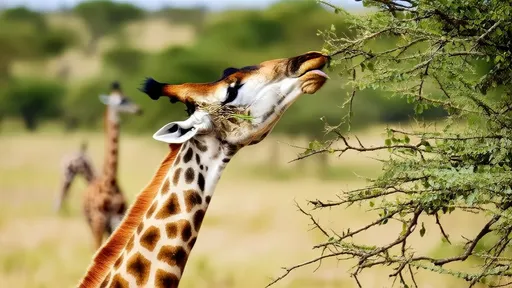
At first glance, the giraffe's tongue appears almost unnatural—a dark, purplish-blue appendage that can extend up to 18 inches to grasp foliage from acacia trees. This remarkable length and dexterity are essential for the animal's survival, allowing it to access nutrient-rich leaves while avoiding the tree's formidable thorns. However, it is the tongue's unusual hue that presents a fascinating evolutionary puzzle, one that scientists have explored through various hypotheses centered on protection and adaptation.
The leading theory suggests that the dark pigmentation serves as a natural sunscreen. Giraffes spend a significant portion of their day feeding, with their tongues constantly exposed to the harsh African sun. The melanin—the same pigment responsible for human skin color—present in the tongue tissue provides critical protection against ultraviolet radiation. Without this pigmentation, the delicate tissue could suffer from severe sunburn, leading to tissue damage, pain, and potentially even cancerous growths over time. This adaptation is particularly vital given the tongue's constant exposure and its role in the animal's primary survival activity.
Another compelling explanation involves the prevention of physical damage. The acacia tree, a staple in the giraffe's diet, is not a passive food source. It is armed with long, sharp thorns that can easily injure unprotected tissue. A toughened, pigmented tongue may be more resistant to abrasions, scratches, and punctures. The darker color could also help mask minor injuries and bleeding, reducing the attraction of blood-seeking insects that might transmit disease. This combination of physical resilience and camouflage would offer a distinct advantage in the giraffe's challenging feeding environment.
Beyond physical protection, the tongue's color may play a role in thermoregulation. Dark surfaces are known to absorb heat more efficiently than light ones. In the cool early mornings of the savanna, a dark tongue might help maintain optimal muscle temperature, ensuring the precision and flexibility needed for delicate feeding. Conversely, the extensive blood vessels in the tongue could then dissipate excess heat later in the day, preventing overheating. This dual functionality would make the tongue a highly efficient thermoregulatory organ, complementing the giraffe's other adaptations for life under the sun.
The evolutionary journey to this trait likely began with random genetic mutations that caused increased melanin production in the tongue tissue. Individuals born with slightly darker tongues would have enjoyed a survival advantage: they could feed for longer periods without injury or discomfort, access more food, and ultimately possess better health and reproductive success. Over millions of years, natural selection would have favored this trait, gradually leading to the uniformly dark tongues seen in all giraffes today. It is a classic example of how a subtle initial change can become a species-wide characteristic through the relentless pressure of the environment.
Interestingly, the giraffe is not alone in this adaptation. Other animals, such as the Chow Chow dog and certain breeds of cattle, also possess blue-black tongues, though the reasons may differ. This parallel evolution suggests that dark pigmentation in exposed mucous membranes can be a highly beneficial trait in specific ecological contexts. For the giraffe, however, the combination of its feeding habits, environmental conditions, and physiological needs makes this feature especially critical and pronounced.
Understanding the why behind the giraffe's blue tongue opens a window into the complex interplay between form and function in evolution. It is a testament to nature's ingenuity—where even the color of an organ can be fine-tuned by natural selection to solve multiple challenges simultaneously. From shielding against solar radiation to resisting physical damage and aiding temperature control, this unique trait underscores the giraffe's remarkable adaptation to its niche.
Next time you see an image of a giraffe wrapped around acacia branches, remember that its dark tongue is not merely a curiosity. It is a beautifully engineered tool, honed by millennia of evolution, that enables this majestic animal to thrive in one of the world's most demanding environments. It serves as a powerful reminder of how evolution leaves its mark on every part of an organism, crafting solutions that are as elegant as they are effective.

By /Aug 25, 2025
By /Aug 25, 2025
By /Aug 25, 2025

By /Aug 25, 2025
By /Aug 25, 2025
By /Aug 25, 2025

By /Aug 25, 2025
By /Aug 25, 2025
By /Aug 25, 2025

By /Aug 25, 2025
By /Aug 25, 2025
By /Aug 25, 2025
By /Aug 25, 2025

By /Aug 25, 2025

By /Aug 25, 2025
By /Aug 25, 2025
By /Aug 25, 2025
By /Aug 25, 2025
By /Aug 25, 2025
By /Aug 25, 2025
