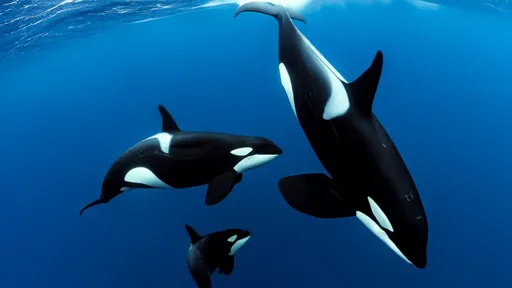
In the vast, liquid realms of our planet, a sophisticated cultural phenomenon unfolds, largely hidden from human observation. Among the most intelligent and socially complex creatures in the ocean, orcas, or killer whales, exhibit a stunning diversity of behaviors that are not hardwired by genetics but are instead learned, refined, and passed down through generations. This cultural transmission, particularly evident in their unique and specialized hunting techniques, paints a picture of distinct orca societies, each with its own set of traditions and knowledge.
The concept of culture in animals, once a controversial and anthropocentric idea, is now widely accepted thanks in large part to the studied behaviors of orcas. Culture, in this context, refers to information or behaviors—shared within a community—that are acquired from conspecifics through some form of social learning. For orcas, this isn't a matter of simple imitation; it is the bedrock of their identity. Different groups, known as ecotypes, have diverged not just in diet and habitat but in a rich tapestry of learned skills that define their very way of life. A calf born into one population will learn a completely different set of survival strategies than one born into another, despite their genetic similarity. This cultural divergence is so profound that some scientists argue these ecotypes may be on a path toward becoming entirely separate species.
Nowhere is this cultural richness more starkly illustrated than in the antipodean waters surrounding Antarctica. Here, one of the most dramatic and coordinated hunting strategies in the natural world is performed by Type B orcas. Their prey of choice: seals resting precariously on unstable platforms of ice. The hunt begins with a collective effort. The pod will identify a seal isolated on a suitable floe. Then, in a breathtaking display of teamwork and precision, they will line up side-by-side and swim rapidly toward the ice, creating a powerful wave in their wake. They dive under the floe at the last moment, allowing the wave they generated to wash over the ice, destabilizing it. Often, a single wave is not enough. The orcas will retreat, regroup, and launch another wave attack, sometimes over multiple attempts. The goal is to wash the hapless seal into the water, where its fate is sealed. This technique is not instinctual; it is a meticulously taught and practiced art form. Calves are observed watching, learning, and eventually participating in these wave-washing hunts, honing their timing and coordination over years under the tutelage of their matriarchs and pod members.
On the opposite side of the globe, in the frigid North Atlantic near Norway, another orca ecotype employs a vastly different, yet equally ingenious, method. Here, herring forms the cornerstone of their diet. To corral massive, shimmering schools of these fish, the orcas use a technique called carousel feeding. The pod works together to herd the herring into a tight, panicked ball near the surface of the water. Once the fish are concentrated, the orcas use their powerful tail flukes to deliver thunderous blows to the shoal. This tail-lobbing or swatting action stuns or kills multiple herring at once, making them easy to pick off. The efficiency of this method relies entirely on flawless communication and cooperation. Each whale understands its role in the encircling maneuver, and the stunning strikes are timed to maximize the payoff. This knowledge is transferred from elder to younger, a cultural inheritance ensuring the pod's continued success and survival through the harsh winters.
Meanwhile, off the rugged coast of Patagonia in Argentina, a different spectacle occurs. Here, orcas have mastered the incredibly daring technique of intentional stranding to hunt sea lion pups on the beach. This is an exceptionally high-risk, high-reward strategy. A single orca, often a female, will launch herself toward the shore, riding a wave onto the beach to snatch an unsuspecting pup from the sand. The margin for error is infinitesimally small; miscalculating the speed or depth of the water could lead to a fatal stranding. Immediately after capturing its prey, the orca must use its powerful body to twist and writhe back into the surf. This is not a skill mastered quickly. Calves and juveniles spend years in the shallows practicing the movements, beaching themselves gently and learning how to maneuver back to deeper water. Their mothers are often seen closely supervising these practice sessions, pushing their young back to safety if they stray too far. This is perhaps one of the most vivid examples of teaching and cultural transmission in the animal kingdom.
Further north, in the serene but nutrient-rich waters of the Pacific Northwest, the resident orca communities tell a different story. Their culture is built around the sophisticated pursuit of salmon, particularly the large and energy-rich Chinook. Their hunting techniques are less about spectacular violence and more about stealth, echolocation, and communication. They share detailed information about the location and movement of salmon runs. Their vocalizations are complex and pod-specific, resembling distinct dialects. This acoustic culture is integral to their coordinated hunting. A successful hunt is a quiet, efficient affair, often involving the sharing of prey among pod members, especially with calves. This cultural focus on salmon specialization, however, has also made them vulnerable. The decline of salmon stocks due to human activity directly threatens the very foundation of their cultural knowledge and social structure.
The existence of such varied and complex hunting cultures among orcas forces a profound shift in how we perceive intelligence and society in the animal kingdom. These are not simple, stimulus-response behaviors. They are evidence of innovation, teaching, learning, and the accumulation of knowledge over time—the hallmarks of culture. A calf's survival depends not just on its genes but on the knowledge passed down from its mother and its community. This cultural lens also redefines the concept of conservation. Protecting these creatures is no longer just about preserving numbers of a species. It is about safeguarding unique cultural identities, ancient traditions, and intricate bodies of knowledge that have evolved over millennia. The loss of a single matriarch can be catastrophic, as she may be the sole keeper of vital hunting techniques or migratory routes for her entire pod.
As we continue to explore the depths, the lives of orcas serve as a powerful reminder that culture is not a uniquely human trait. In the coordinated waves of Antarctica, the tail-lobs of Norway, the daring beach assaults of Patagonia, and the acoustic communication of the Pacific Northwest, we find compelling evidence of minds that are not only intelligent but are deeply cultural. Their world is one of learned traditions, shared knowledge, and social bonds that define their existence. Understanding and appreciating this complexity is not just a scientific pursuit; it is an ethical imperative, compelling us to ensure that these magnificent cultural beings continue to thrive in the world's oceans for generations to come.

By /Aug 25, 2025
By /Aug 25, 2025
By /Aug 25, 2025

By /Aug 25, 2025
By /Aug 25, 2025
By /Aug 25, 2025
By /Aug 25, 2025
By /Aug 25, 2025

By /Aug 25, 2025
By /Aug 25, 2025
By /Aug 25, 2025
By /Aug 25, 2025
By /Aug 25, 2025
By /Aug 25, 2025
By /Aug 25, 2025
By /Aug 25, 2025
By /Aug 25, 2025
By /Aug 25, 2025
By /Aug 25, 2025
By /Aug 25, 2025
