In the dense forests of New Caledonia, a remarkable avian intellect is at work. Here, the New Caledonian crow has been observed performing a feat long considered uniquely human: the crafting and use of tools. These jet-black birds aren't merely picking up convenient twigs to poke at insects; they are actively shaping raw materials into functional implements, displaying a level of cognitive sophistication that has forced scientists to radically rethink the boundaries of animal intelligence.
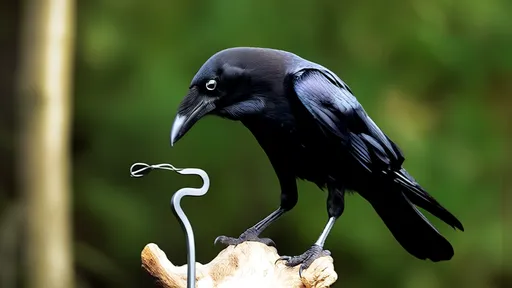
The behavior is both methodical and inventive. A crow will carefully select a specific type of fork-shaped twig. It will then spend minutes, sometimes longer, meticulously stripping it of leaves and smaller offshoots, not randomly, but with a clear goal in mind. The final product is a refined hook, a tool designed for a specific purpose. The bird will then fly to a tree, often a decaying log teeming with grubs and other insects hidden deep within crevices, and use its handmade hook to expertly fish out its prey—a task impossible with a straight stick.
This is not simple mimicry. Research led by laboratories such as those at the University of Auckland has demonstrated that these crows possess what is known as analogical reasoning. They can see a problem, understand the properties required in a solution, and then create an object that meets those requirements. In controlled experiments, crows have been presented with puzzles they have never encountered before, such as retrieving a small bucket of food from the bottom of a vertical tube. Faced with this novel challenge, they will immediately scout their environment, find a piece of wire, and bend it into a hook to lift the bucket out. They are not repeating a learned behavior; they are inventing a new one on the spot.
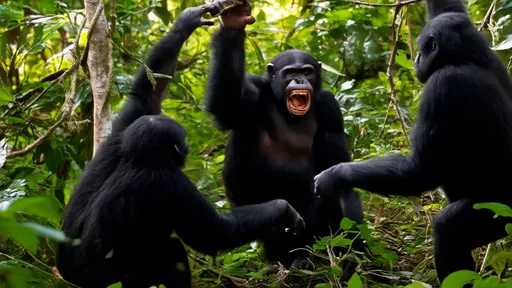
The implications of this are profound. For decades, tool use was a hallmark of humanity, a key dividing line between us and the rest of the animal kingdom. While other species like chimpanzees were observed using tools, the act of manufacturing them—transforming an object into a new form with a specific function—was seen as a cognitive leap of a different order. The New Caledonian crow, along with a handful of other species, has completely blurred that line. Their ability suggests that the cognitive seeds for technological innovation, a driving force of human civilization, may be more widespread in the animal kingdom than we ever imagined.
But how did they become so smart? The evolutionary pressures are a subject of intense study. One compelling theory suggests that their intelligence is a direct result of their dietary needs and ecological niche. Their primary food source, wood-boring grubs, is highly nutritious but incredibly difficult to access without the right equipment. In this environment, a bird that could invent a key—a hook—would have a massive survival advantage over its peers. This created a feedback loop: smarter birds got more food, lived longer, and produced more offspring, passing on their cognitive abilities and gradually pushing the entire species toward greater intelligence.
Furthermore, this knowledge isn't confined to a single brilliant bird; it appears to be cultural. Young crows spend a significant amount of time watching their parents and other adults forage. This period of observation is crucial. They are not just learning what to do, but how to think about the problem. Different groups of crows, separated geographically, have even been observed crafting slightly different styles of tools, suggesting regional variations and traditions that are passed down through generations—a phenomenon strikingly similar to human culture.
The study of corvid intelligence has fundamentally reshaped our understanding of the avian brain. The old derogatory term "bird-brained" could not be more inaccurate. Birds do not have a neocortex like mammals; their brains are structured differently. However, they have developed a different region, the pallium, which has evolved dense clusters of neurons that allow for complex information processing. In essence, evolution has found two distinct paths to achieving high intelligence: the mammalian way and the avian way. The crows prove that a large cortex is not a prerequisite for advanced cognitive functions like problem-solving, future planning, and even the potential for consciousness.
Beyond toolmaking, these birds exhibit a suite of behaviors that point to a rich inner life. They recognize human faces and can hold grudges against individuals who have threatened them. They engage in complex social interactions and play, which some scientists argue is a sign of intelligence. They can solve multi-step puzzles that require planning several moves ahead, indicating a capacity for foresight that was once believed to be exclusively human.
As research continues, the New Caledonian crow stands as a powerful testament to the convergent evolution of intelligence. It challenges our anthropocentric view of the world and forces a humbling recognition: the capacity for innovation, culture, and complex thought is not our sole inheritance. In the tangled jungles of a Pacific island, a bird with a tiny brain is engineering tools, teaching its young, and quietly claiming its title as the undeniable智商天花板 (zhìshāng tiānhuābǎn)—the ceiling of intelligence—in the avian world.

By /Aug 25, 2025
By /Aug 25, 2025
By /Aug 25, 2025

By /Aug 25, 2025

By /Aug 25, 2025

By /Aug 25, 2025

By /Aug 25, 2025

By /Aug 25, 2025
By /Aug 25, 2025

By /Aug 25, 2025
By /Aug 25, 2025
By /Aug 25, 2025
By /Aug 25, 2025

By /Aug 25, 2025

By /Aug 25, 2025
By /Aug 25, 2025
By /Aug 25, 2025
By /Aug 25, 2025
By /Aug 25, 2025

By /Aug 25, 2025
