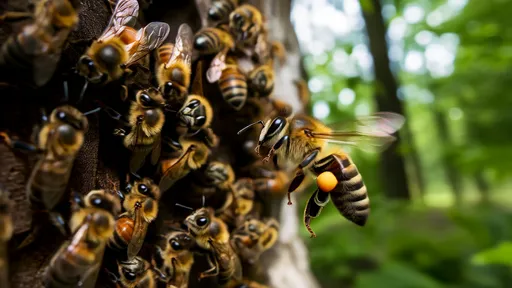
In the intricate world of insect societies, honeybees exhibit one of nature's most fascinating collective decision-making processes: the selection of a new home. When a colony outgrows its hive or faces environmental pressures, it embarks on the critical task of finding a suitable new nest site. This isn't a decision made by a single leader but rather a democratic process involving thousands of bees, each contributing to the final choice. The mechanism is a marvel of efficiency and collaboration, ensuring the survival and prosperity of the entire swarm.
The process begins with scouting. Several hundred experienced bees, often older foragers, leave the swarm cluster to search for potential nesting sites. These scouts explore the surrounding environment, sometimes traveling kilometers in their quest. They evaluate cavities in trees, rock crevices, or even human-made structures, assessing each location against a set of innate criteria: size (preferably around 40 liters), entrance height and orientation, dryness, and protection from predators and the elements. This initial phase is chaotic yet purposeful, with scouts independently covering vast territories to compile a list of candidates.
Upon returning to the swarm, a scout who has found a promising site performs a waggle dance on the surface of the cluster. This dance, first decoded by Karl von Frisch, is a sophisticated form of communication that conveys the direction, distance, and quality of the site. The vigor and duration of the dance reflect the scout's enthusiasm; a longer, more energetic dance indicates a superior location. Other bees observe these dances and may themselves be inspired to visit the advertised site. If they agree with the assessment, they return and perform their own dances, amplifying the signal for that particular option.
This creates a competitive feedback loop among the different sites. High-quality locations generate more "advertisements" as satisfied scouts recruit others. Over time, a consensus begins to emerge. Bees gradually abandon dances for poorer sites and converge on promoting the best option. The process isn't instantaneous; it can take hours or even days, allowing for thorough evaluation and comparison. Researchers have noted that this competition ensures that the best site, not just the first good one found, wins out.
A critical threshold is reached when a sufficient number of scouts—a quorum—are dancing for the same site. This isn't a fixed number but a density-dependent signal that the decision is made. Once this quorum is sensed, the scouts initiate the next phase: preparing the swarm for liftoff. They produce piping sounds, high-frequency vibrations that run through the cluster, signaling that it's time to warm up their flight muscles and get ready to move. The transition from debate to action is swift and coordinated.
Finally, the entire swarm takes to the air. The scouts who had promoted the chosen site now guide the cloud of bees to their new home. They do this by flying through the swarm in the direction of the nest, ensuring the group moves as a cohesive unit. The efficiency is astounding; a swarm of thousands can relocate to a new cavity several kilometers away with remarkable precision, all without a central command structure. This collective intelligence, where no single bee understands the entire process but each contributes a small part, results in a decision that is often better than any individual could make alone.
The honeybees' method is a powerful example of swarm intelligence. It demonstrates how a group can solve complex problems through simple, localized interactions and decentralized control. This phenomenon has inspired algorithms in technology and robotics, helping engineers design systems for fault-tolerant networking and collaborative robotics. The bees' democracy is not just a biological curiosity; it's a lesson in efficiency, resilience, and the power of the collective.

By /Aug 25, 2025
By /Aug 25, 2025
By /Aug 25, 2025

By /Aug 25, 2025

By /Aug 25, 2025
By /Aug 25, 2025

By /Aug 25, 2025
By /Aug 25, 2025

By /Aug 25, 2025

By /Aug 25, 2025

By /Aug 25, 2025

By /Aug 25, 2025

By /Aug 25, 2025

By /Aug 25, 2025

By /Aug 25, 2025
By /Aug 25, 2025

By /Aug 25, 2025

By /Aug 25, 2025

By /Aug 25, 2025

By /Aug 25, 2025
