In the vast and varied tapestry of the animal kingdom, few creatures capture the imagination quite like the kangaroo. This iconic marsupial, a symbol of the Australian wilderness, is renowned for its powerful hind legs, its distinctive hopping gait, and, most curiously, its robust and muscular tail. For centuries, observers have marveled at the kangaroo's ability to move with such explosive speed and graceful balance. While its legs are the obvious engines of this locomotion, a closer examination reveals a more complex story. The tail, far from being a mere counterbalance or accessory, plays an integral and active role in the kangaroo's movement, leading many biologists to provocatively—and quite accurately—dub it the animal's "third leg."
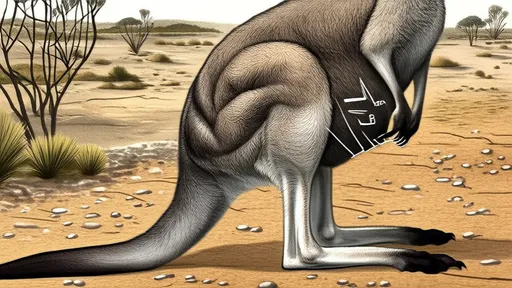
The common perception of a tail is that of a passive appendage, used for signaling, swatting flies, or perhaps rudimentary steering. The kangaroo’s tail shatters this convention. It is a formidable structure, thick with tendons and powerful muscles, accounting for a significant portion of the animal's body mass. This isn't a whip or a rudder; it is a load-bearing limb. When a kangaroo is moving slowly, grazing on grasses and shrubs, it adopts a unique pentapedal gait. It plants its two forelimbs and its tail on the ground, swinging its two large hind legs forward together between them. In this slow, walking motion, the tail acts as a crutch, supporting the animal's weight and providing the necessary leverage to propel its heavy hindquarters forward. This alone distinguishes it from virtually all other tails in the mammalian world, transforming it from an accessory into a primary point of contact with the earth.
However, it is during the spectacular act of hopping that the tail's true engineering genius is fully unveiled. Hopping, or saltation, is an incredibly efficient form of locomotion for covering large distances in open terrain, but it presents a profound physics problem: stability. Launching a body weighing up to 90 kilograms into the air with every bound creates immense forces that must be carefully managed to prevent the animal from tipping over mid-flight or upon landing. This is where the tail becomes the maestro of balance. As the kangaroo pushes off with its powerful hind legs, the tail swings downward and backward, acting as a counterweight to the forward momentum of the upper body. This counterbalancing act is crucial for maintaining a stable trajectory and preventing a disastrous forward pitch.
The tail's role is not limited to being a simple pendulum. It is a dynamic stabilizer, making constant, subtle adjustments throughout the hop. During the airborne phase, small movements of the tail help to control the animal's attitude, much like a tightrope walker uses a pole. But the most astonishing action occurs upon landing. The hind legs touch down first, absorbing the tremendous impact. Almost simultaneously, the tail makes contact with the ground. In this critical moment, it does not just drag behind; it actively pushes. The massive muscles in the tail contract, delivering a powerful thrust against the earth. This push accomplishes two vital tasks. First, it provides a significant portion of the propulsive force needed for the next hop, working in concert with the legs. Studies using force plates have shown that during high-speed hopping, the tail can generate as much propulsive force as the front and hind legs combined. Second, and just as importantly, this push stabilizes the kangaroo's body. It counteracts the torque generated by the landing, keeping the torso upright and ensuring the center of mass remains perfectly aligned for the next takeoff. It is this powerful, active push that truly earns the tail its title as a third leg.
This unique anatomical adaptation is a masterpiece of evolutionary design. The skeleton of the tail is comprised of a series of strong vertebrae, which provide a rigid yet flexible framework. But the real power lies in the musculature. The caudofemoralis muscle, a large mass connecting the tail to the femur bone of the leg, is particularly key. This muscle is a primary engine for both tail movement and, by extension, for propulsion. The metabolic efficiency gained from this system is extraordinary. The tendons in the kangaroo's legs and tail act like elastic springs, storing and releasing energy with each hop. This is why a kangaroo can maintain high speeds for long distances while expending relatively little energy; its body is quite literally bouncing along, recycling momentum with every bound, with the tail as a central component of this elastic system.
To simply call the kangaroo's tail a balancing aid is a profound understatement. It is a multifunctional biomechanical marvel, a limb that has been co-opted for a role far beyond its original evolutionary purpose. It is a crutch for walking, a dynamic counterbalance in mid-air, and a powerful engine for propulsion on landing. It provides stability, generates force, and contributes significantly to the kangaroo's renowned energetic efficiency. The next time you see a kangaroo bounding across an open plain, appearing almost to float with each effortless hop, take a moment to watch its tail. See the deliberate, powerful swing and the definitive push-off from the ground. You are not just watching an animal hop on two legs; you are witnessing a masterclass in tripedal locomotion, a unique dance of balance and power where the tail is undeniably the third partner.

By /Aug 25, 2025
By /Aug 25, 2025
By /Aug 25, 2025

By /Aug 25, 2025
By /Aug 25, 2025
By /Aug 25, 2025
By /Aug 25, 2025
By /Aug 25, 2025
By /Aug 25, 2025

By /Aug 25, 2025
By /Aug 25, 2025
By /Aug 25, 2025
By /Aug 25, 2025
By /Aug 25, 2025
By /Aug 25, 2025
By /Aug 25, 2025
By /Aug 25, 2025
By /Aug 25, 2025
By /Aug 25, 2025
By /Aug 25, 2025
