In the quiet stillness of the African savanna or the dense forests of Asia, a profound ritual unfolds when an elephant dies. For decades, observers have reported behaviors that seem to mirror human mourning—lingering near the body, touching the bones gently with their trunks, and even covering the deceased with leaves and branches. These poignant scenes have sparked a compelling question in the scientific community and among animal lovers alike: do elephants truly mourn their dead, or are we simply projecting human emotions onto their actions?
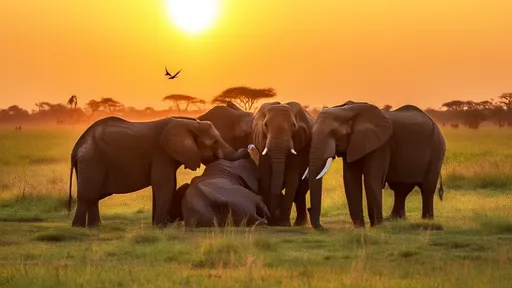
The evidence, gathered through years of meticulous field research, suggests that elephant responses to death are complex, socially nuanced, and strikingly consistent across different populations and species. When a member of the herd dies, elephants have been observed standing vigil over the body for hours, sometimes days. They often approach cautiously, exploring the remains with their sensitive trunks, which are capable of detecting subtle scents and textures. This isn’t a fleeting curiosity; elephants have been known to revisit the bones of deceased relatives years after their passing, gently caressing the skull or tusks as if in remembrance.
One of the most touching accounts comes from researchers who documented a matriarch’s death in Kenya’s Samburu National Reserve. After she passed, her family gathered around her, rumbling softly and nudging her body as if trying to rouse her. They then broke branches from nearby trees and laid them over her, a behavior that has been recorded multiple times in wild populations. Similarly, in India, elephants have been seen burying their dead under leaves and soil, particularly when the deceased is a calf. These acts go beyond mere instinct; they indicate a recognition of death and a communal response to loss.
But what drives these behaviors? Scientists caution against anthropomorphism—the attribution of human emotions to animals—but many argue that elephants display something akin to grief. Their large brains, highly developed social structures, and long-lasting bonds between family members provide a foundation for complex emotional experiences. Elephants live in tight-knit matriarchal societies where individuals rely on one another for survival, and the death of a member, especially a leader, can disrupt the group’s dynamics for years. The prolonged interest in bones and carcasses may serve as a way to process this loss and reinforce social cohesion.
Moreover, elephants exhibit signs of stress and depression after a death. Studies have shown changes in hormone levels, such as elevated cortisol, indicating physiological stress. They may become withdrawn, eat less, or alter their travel routes to avoid places where a herd member died. In some cases, elephants have been observed carrying the bones of deceased calves for miles, refusing to leave them behind. This persistence hints at a deep emotional attachment rather than a simple reaction to a novel object.
Communication also plays a role in these rituals. Elephants produce low-frequency rumbles that can travel long distances, and these calls may serve to announce a death or gather the group. Researchers have recorded distinct vocalizations around carcasses—different from those used in other contexts—suggesting that elephants have a specific way of responding to mortality. This vocal behavior, combined tactile exploration, points to a shared understanding of death within the herd.
However, not all responses are gentle. In rare instances, elephants have been seen kicking or dragging bodies, which might seem aggressive or disrespectful to human eyes. But experts interpret this as part of their confusion or frustration—an attempt to comprehend why their companion is no longer moving or responding. It underscores the complexity of their reactions, which can range from tender to turbulent, much like human grief.
The cultural knowledge of death also appears to be passed down through generations. Calves learn how to respond by watching adults, and herds with older matriarchs often show more pronounced mourning behaviors. This intergenerational transfer of practice suggests that elephant "funerals" are not just innate instincts but learned traditions, adding another layer to their sophistication.
Of course, skepticism remains. Some researchers argue that these behaviors could be driven by curiosity, confusion, or even the scent of decomposition rather than emotional mourning. Elephants are intelligent and investigative animals, and their interactions with dead bodies might stem from a desire to understand the cause of death, especially if it was due to predators or humans. In regions where elephants are threatened by poaching, they may become hyper-vigilant around carcasses as a survival mechanism.
Yet, the consistency and emotional depth of these rituals across diverse environments make a strong case for genuine mourning. Unlike many other animals, elephants don’t abandon their dead quickly; they engage repeatedly and with evident care. They also distinguish between elephant remains and those of other species, paying far more attention to the bones of their own kind. This selectivity implies a special significance attached to fellow elephants.
In captivity, where elephants form deep bonds with caregivers and other elephants, similar behaviors occur. When an elephant dies in a zoo or sanctuary, others often refuse to leave the body, emitting distress calls and showing signs of agitation. These settings allow for closer observation, and caretakers frequently report what can only be described as grief—lasting days or weeks, affecting the group’s mood and behavior profoundly.
Ultimately, the weight of evidence leans toward elephants experiencing a form of mourning that, while not identical to human grief, is deeply felt and socially meaningful. Their actions reflect an awareness of mortality, a capacity for empathy, and a commitment to their community that resonates with our own experiences of loss. As scientists continue to study these magnificent creatures, we may uncover even more about the rich emotional lives hidden behind their wise eyes and solemn ceremonies.
So, do elephants mourn their dead? It seems they do, in their own intricate way. Their funerals are a testament to the bonds that tie them together—a silent, powerful language of touch, sound, and memory that transcends species and reminds us of the universal impact of loss.

By /Aug 25, 2025
By /Aug 25, 2025
By /Aug 25, 2025

By /Aug 25, 2025

By /Aug 25, 2025
By /Aug 25, 2025

By /Aug 25, 2025
By /Aug 25, 2025
By /Aug 25, 2025

By /Aug 25, 2025
By /Aug 25, 2025
By /Aug 25, 2025
By /Aug 25, 2025

By /Aug 25, 2025
By /Aug 25, 2025
By /Aug 25, 2025
By /Aug 25, 2025

By /Aug 25, 2025
By /Aug 25, 2025
By /Aug 25, 2025
