In the vast wilderness where survival is a daily challenge, the wolf pack represents one of nature's most sophisticated social structures. The education of wolf pups stands as a remarkable example of animal parenting that goes far beyond basic instinct, revealing complex teaching methods that have evolved over millennia.
From the moment wolf pups open their eyes in their den's dim light, their education begins. The entire pack participates in raising the young, with not just the biological parents but also aunts, uncles, and older siblings contributing to what can only be described as a comprehensive educational system. This collective approach ensures that knowledge passes efficiently from one generation to the next, preserving hunting techniques, social rules, and survival strategies that have kept wolf populations thriving despite numerous environmental challenges.
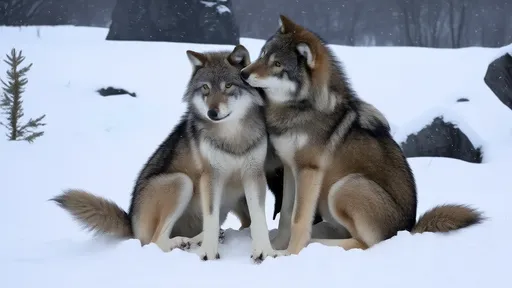
The early weeks of a wolf pup's life focus on fundamental social bonding. During this period, pups learn to recognize pack members through scent, sound, and sight. They discover their place in the pack hierarchy through gentle nudges, playful nips, and subtle body language cues from older wolves. This early socialization creates the foundation for the complex cooperative behaviors that will later enable the pack to hunt large prey and defend their territory effectively.
As pups grow more mobile, their education expands beyond the den. Adult wolves begin taking them on short excursions, introducing them to the sights, sounds, and smells of their territory. These expeditions serve as living classrooms where pups learn to identify different animal scents, recognize potential dangers, and understand the geography of their home range. The adults demonstrate how to navigate difficult terrain, cross streams, and move silently through the forest—lessons that could mean the difference between life and death in their future.
Play represents a crucial component of wolf education, serving as both physical training and social development. The rough-and-tumble games that seem like simple recreation actually teach pups vital skills. Through play fighting, they practice the biting and holding techniques they'll need for hunting. Through chase games, they develop speed, agility, and stamina. Perhaps most importantly, play teaches them the boundaries of acceptable behavior—how hard they can bite before eliciting a painful response, and how to read the subtle signals that indicate when a playmate has had enough.
Hunting education begins with observation. Pups watch from safe distances as the pack coordinates to bring down prey, absorbing strategies and techniques through careful observation. Initially, adults bring back injured small animals for pups to practice on, creating controlled learning environments where mistakes don't mean starvation for the pack. As pups develop skills, they progress to participating in actual hunts, starting with easier targets and gradually taking on more significant roles under the watchful eyes of experienced hunters.
Communication lessons form another critical aspect of wolf education. Pups learn the complex language of howls, growls, barks, and body postures that enable the pack to function as a coordinated unit. They discover which howls gather the pack for hunting and which warn of danger. They learn to interpret the subtle differences in vocalizations that indicate everything from excitement about a successful hunt to anxiety about intruders in their territory. This linguistic education ensures they can both understand messages and contribute effectively to pack communication.
Discipline and correction play important roles in wolf education. When pups step out of line—whether by challenging authority too aggressively, wandering too far from the den, or failing to respond appropriately to commands—older wolves administer corrections. These aren't brutal punishments but measured responses designed to reinforce social rules. A low growl, a gentle but firm hold on the muzzle, or temporary exclusion from activities all serve to teach boundaries and respect for pack structure.
The education of wolf pups continues well into their second year, with the most complex skills—like leading hunts and making strategic decisions about territory defense—being taught to adolescents who have already mastered basic survival techniques. This extended educational period reflects the sophistication of wolf society and the importance of thorough preparation for adult responsibilities.
Remarkably, wolf education demonstrates flexibility and adaptation. Packs living in different environments emphasize different skills. Arctic wolves spend more time teaching survival in extreme cold and hunting techniques specific to their prey animals, while wolves in forested areas focus more on navigation through dense vegetation and ambush strategies. This environmental adaptation shows that wolf education isn't purely instinctual but involves conscious teaching of locally relevant knowledge.
The success of wolf education becomes evident when young wolves eventually leave their natal packs to start their own families. They carry with them not just genetic inheritance but accumulated knowledge passed down through generations—knowledge about migration patterns of prey, medicinal plants, water sources that remain unfrozen in winter, and countless other survival insights that would take a lifetime to learn independently.
Scientists studying wolf behavior continue to be amazed by the sophistication of this educational system. The transfer of knowledge from experienced wolves to youngsters represents a form of culture in the animal kingdom—a cumulative wisdom that grows richer with each generation. This cultural knowledge allows wolf packs to adapt to changing environments more quickly than genetic evolution alone would permit.
Understanding how wolves educate their young provides valuable insights into the origins of teaching behavior in animals, including humans. It challenges old assumptions about what constitutes "instinct" versus "learned behavior" and reveals the deep evolutionary roots of education as a survival strategy. The wolf pack demonstrates that teaching isn't exclusively human but appears in sophisticated forms throughout the animal kingdom.
Next time you hear the haunting melody of a wolf howl cutting through the night, remember that you're hearing not just a primal call but the result of an extensive educational process—the voice of an animal that has learned through careful instruction how to survive, communicate, and thrive in nature's classroom. The lessons taught in wolf packs represent some of the most sophisticated parenting found in the animal world, reminding us that education remains nature's most powerful tool for ensuring survival across generations.

By /Aug 25, 2025
By /Aug 25, 2025
By /Aug 25, 2025

By /Aug 25, 2025

By /Aug 25, 2025
By /Aug 25, 2025

By /Aug 25, 2025

By /Aug 25, 2025

By /Aug 25, 2025
By /Aug 25, 2025

By /Aug 25, 2025
By /Aug 25, 2025

By /Aug 25, 2025
By /Aug 25, 2025

By /Aug 25, 2025
By /Aug 25, 2025
By /Aug 25, 2025
By /Aug 25, 2025
By /Aug 25, 2025

By /Aug 25, 2025
