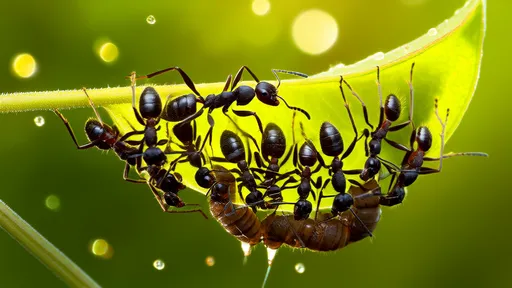
In the hidden corners of gardens and forests, an ancient agricultural practice unfolds, one that predates human farming by millions of years. Ants, those tiny architects of the insect world, have mastered the art of domestication, cultivating aphids much like humans tend to livestock. This symbiotic relationship is a fascinating example of evolutionary ingenuity, where ants provide protection and care in exchange for a sweet, nutritious reward.
The foundation of this relationship lies in the aphid’s ability to produce honeydew, a sugary excretion that ants find irresistible. Aphids feed on plant sap, which is rich in sugars but poor in other nutrients. To extract the necessary proteins, they process large volumes of sap, excreting the excess sugars in the form of honeydew. For ants, this substance is a valuable energy source, and they have evolved behaviors to harvest it efficiently.
Ants don’t merely stumble upon aphids; they actively manage them. They corral aphids into groups, often moving them to optimal feeding sites on plants. Some species even construct shelters out of soil or plant material to protect their "herds" from predators and harsh weather. This level of care ensures a steady supply of honeydew, turning aphids into living, breathing farms.
Communication plays a key role in this system. Ants use tactile signals, such as stroking the aphids with their antennae, to stimulate honeydew production. This gentle coaxing is often enough to prompt the aphids to release droplets of the sweet fluid, which the ants then consume. It’s a refined form of milking, honed over eons of coevolution.
But the ants’ responsibilities don’t end there. They fiercely defend their aphid charges from predators like ladybugs and lacewings. In some cases, ants have been observed removing dead or diseased aphids from the group, a form of hygiene management that benefits the overall health of the herd. This protective behavior ensures the longevity and productivity of their honeydew sources.
Interestingly, ants also influence aphid reproduction. Some studies suggest that ants may prioritize certain aphid species or even individuals that produce more honeydew, effectively selecting for traits that benefit them. This subtle form of artificial selection mirrors human practices in animal husbandry, where desirable traits are encouraged over generations.
For the aphids, the relationship is equally beneficial. Under the ants’ protection, they enjoy reduced predation and exposure to environmental stressors. Some aphid species have even evolved to become obligate mutualists, relying entirely on ants for survival. Their bodies may produce more honeydew or lack defensive structures, knowing their caretakers will handle threats.
However, this partnership isn’t without its conflicts. Aphids may sometimes attempt to escape their ant guardians, especially if resources are scarce. Ants, in turn, have been known to punish uncooperative aphids by consuming them—a stark reminder that this is a relationship built on mutual benefit, not altruism.
The evolutionary implications are profound. This mutualism has shaped the biology and behavior of both ants and aphids, driving adaptations that reinforce their interdependence. For example, some aphids have lost the ability to drop from plants when threatened, relying instead on ants for defense. Ants, meanwhile, have developed specialized behaviors for managing their herds.
Human agriculture often views such relationships through a lens of exploitation, but the ant-aphid dynamic is more nuanced. It’s a trade-off: aphids gain protection and care, while ants secure a reliable food source. This balance has persisted for millions of years, a testament to its effectiveness.
In the grand tapestry of nature, the ant-aphid relationship stands out as a remarkable example of interspecies cooperation. It challenges our understanding of domestication, showing that even the smallest creatures can engage in practices we once thought uniquely human. As we continue to study these interactions, we may uncover even more insights into the complexities of life on Earth.

By /Aug 25, 2025
By /Aug 25, 2025
By /Aug 25, 2025

By /Aug 25, 2025
By /Aug 25, 2025
By /Aug 25, 2025
By /Aug 25, 2025
By /Aug 25, 2025
By /Aug 25, 2025
By /Aug 25, 2025
By /Aug 25, 2025
By /Aug 25, 2025
By /Aug 25, 2025
By /Aug 25, 2025
By /Aug 25, 2025
By /Aug 25, 2025
By /Aug 25, 2025
By /Aug 25, 2025
By /Aug 25, 2025
By /Aug 25, 2025
