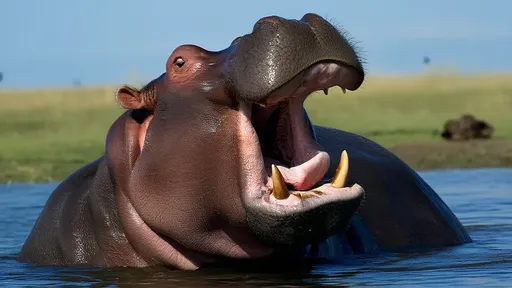
In the sweltering heat of the African savanna, where the sun beats down with relentless intensity, one might expect its inhabitants to seek shade or water to escape the scorching rays. Yet the hippopotamus, a colossal semi-aquatic mammal, spends hours lounging in the open, seemingly unfazed. The secret to its resilience lies not in a hidden behavior or a thick hide alone, but in a remarkable biological adaptation: a sweat that acts as a natural, multi-functional sunscreen.
This is no ordinary perspiration. Often mischaracterized as "blood sweat," the viscous fluid secreted by hippos is initially colorless but undergoes a dramatic transformation. Upon exposure to air and sunlight within minutes, it turns a striking reddish-orange, eventually deepening to a brownish hue. This visually arresting phenomenon has fueled myths for centuries, with ancient legends suggesting hippos sweated blood. Modern science, however, reveals a far more fascinating truth about this pinkish secretion.
The magic of this sweat lies in its complex chemical composition. It is a sophisticated cocktail of two unique pigments: one red, dubbed hipposudoric acid, and one orange, known as norhipposudoric acid. These compounds are absent in virtually all other animals, making the hippo's sweat a biological marvel. Researchers have discovered that these acids are highly acidic and possess extraordinary properties that are crucial for the hippo's survival in its harsh environment.
Foremost among these properties is potent sunblock capability. The pigments are exceptionally effective at absorbing ultraviolet light from the sun, creating a physical barrier that protects the animal’s sensitive skin beneath. Unlike the hairy coats of many African mammals that provide shade, a hippo’s skin is largely hairless and highly vulnerable to severe sunburn. The secretion, therefore, is its first and most important line of defense against DNA damage and painful burns under the relentless tropical sun.
But the benefits of this miraculous fluid extend far beyond sun protection. It acts as a powerful, all-in-one skincare regimen. The same acids that block UV rays also function as a robust antimicrobial agent. Hippos frequently engage in territorial fights, resulting in wounds and cuts. By coating their skin in this secretion, they create a hostile environment for bacteria, preventing infections from taking hold in these injuries and in the muddy waters they inhabit, which are teeming with pathogens.
Furthermore, the sweat serves as a natural moisturizer and regulator. Despite spending their days in water, hippos are prone to dehydration under the extreme heat. The viscous, oily nature of the secretion forms a barrier on their skin that significantly reduces moisture loss, helping them conserve vital fluids. It also may aid in thermoregulation, though its primary role is protective rather than cooling like human sweat.
The intricate biological process behind this secretion is a testament to evolutionary ingenuity. Specialized glands beneath the skin produce the colorless precursor liquid. As it is exuded onto the skin's surface, a chemical reaction akin to polymerization occurs. The molecules of hipposudoric and norhipposudoric acid link together and interact with sunlight and oxygen, leading to the rapid color change and the activation of their protective properties. This on-the-spot activation ensures the sunscreen is freshly formulated and maximally effective whenever it is needed.
Scientists are looking at this natural wonder with great interest, hoping to unlock its secrets for human application. The quest for new, effective, and natural sunscreens is more urgent than ever. The synthetic compounds found in many commercial sunblocks, like oxybenzone, have come under scrutiny for their potential environmental impact, particularly their role in coral reef bleaching. A bio-inspired sunscreen derived from hippo sweat pigments could offer a powerful, biodegradable alternative that protects human skin without harming aquatic ecosystems.
Moreover, the antimicrobial prowess of hipposudoric acid opens doors in medical science. In an era of rising antibiotic resistance, finding new agents to fight bacteria is critical. Research into synthesizing these compounds could lead to novel topical treatments for wounds, preventing infections in hospitals and clinics. The hippo’s sweat, therefore, isn’t just a curiosity; it is a potential goldmine for biomedical innovation.
Despite our advanced technology, nature often holds the blueprints for the most elegant solutions. The hippopotamus, an animal that has evolved over millions of years, developed a perfect, multi-purpose skin protectant long before humans conceived of sunscreen or antiseptic cream. Its pink sweat is a brilliant adaptation that ensures survival through integrated sunblock, antibiotic, and moisturizing properties. It is a vivid reminder of the wonders that await discovery in the natural world and how much we can still learn from its inhabitants.

By /Aug 25, 2025

By /Aug 25, 2025
By /Aug 25, 2025

By /Aug 25, 2025

By /Aug 25, 2025

By /Aug 25, 2025

By /Aug 25, 2025

By /Aug 25, 2025

By /Aug 25, 2025

By /Aug 25, 2025

By /Aug 25, 2025
By /Aug 25, 2025
By /Aug 25, 2025

By /Aug 25, 2025
By /Aug 25, 2025

By /Aug 25, 2025

By /Aug 25, 2025

By /Aug 25, 2025

By /Aug 25, 2025
By /Aug 25, 2025
